I used to think I could do this alone. Maybe you’ve felt that way too. You have your Bible, your podcasts, and your Sunday morning routine. Why do you need to get tangled up in the messiness of other people?
I learned the hard way that going solo isn’t holiness. It’s just isolation. And isolation is a dangerous place to live.
Here is what I’ve learned after years of trying to figure this out on my own: You cannot love God and dislike His people. You can try. But eventually, the two get tangled together. If we are being honest, community isn’t just a nice bonus to the Christian life. It is the workshop where our faith actually gets built.
Why Your Phone Isn’t Enough
We live in the most connected time in history, yet loneliness is an epidemic. We scroll through highlight reels and call it friendship. But digital connection rarely bleeds into the kind of fellowship that saves your life at 2:00 AM.
Real fellowship requires skin in the game. It requires showing up when you’re tired, being known when you’d rather hide, and speaking truth when it’s easier to stay quiet.
There is a reason the early church didn’t just text each other. They “devoted themselves to the apostles’ teaching and to fellowship, to the breaking of bread and to prayer” (Acts 2:42). They shared meals, possessions, and burdens. They lived like a family because, spiritually speaking, they were one.
The Iron That Sharpens (Even When It Hurts)
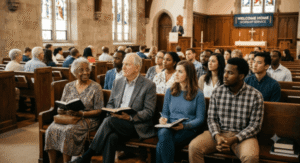
Let’s be honest about what real community feels like. Sometimes, it’s uncomfortable. You join a small group or start sitting in a row with regulars, and suddenly your flaws are on display. You can’t hide your bad mood when you’re passing the bread basket. You can’t pretend you have it all together when someone asks how your week actually was.
That discomfort is actually a gift.
As iron sharpens iron, so one person sharpens another. (Proverbs 27:17)
Sharpening isn’t a gentle process. It grinds off the rough edges. When I surround myself only with people who agree with everything I say and never challenge my blind spots, I don’t grow. I just get more comfortable in my immaturity. A healthy community loves you enough to not let you stay the same.
A Safety Net for Hard Seasons
I’ll never forget the week my world fell apart. The details aren’t important, but what saved me was a text from a guy in my group who simply said, “We’re bringing dinner. Don’t argue.”
He didn’t offer a sermon. He offered presence. That is fellowship in action.
When the Bible talks about the body of Christ, it uses the metaphor of a physical body for a reason. If your hand gets cut, your whole body rushes to the site to heal it. Your foot doesn’t say, “That’s a hand problem. Not my jurisdiction.”
If one part suffers, every part suffers with it; if one part is honored, every part rejoices with it. (1 Corinthians 12:26)
You need people who will rush to your bleeding. And you need to be the kind of person who rushes to theirs. You can’t do that from a distance.
How to Find Your People
Maybe you’re reading this and realizing you don’t have this. You feel like a lone wolf in a crowded church. Finding community can feel intimidating, especially if you’ve been burned before.
Here is the secret that took me too long to learn: you don’t find community. You build it.
It starts with showing up to the same place consistently. It means sitting in the same row, joining a group even when it feels awkward, and being the one to initiate the coffee invite. Stop waiting for someone to adopt you. Start looking for someone else to adopt.
Look for people who are hungry for more than just surface-level small talk. Look for people who aren’t trying to impress anyone. They are usually the ones sitting in the back, just as nervous as you are.
The Bottom Line
We were never meant to be spiritual islands. The whole narrative of Scripture is God taking a people for Himself, not just individuals. Jesus didn’t die to make you a better solitary believer. He died to bring you into a family.
If you are tired of feeling alone in your faith, take a risk. Put down your phone. Walk across the lobby. Knock on the neighbor’s door. Join the group that meets in the cramped living room with the bad coffee.
It will be messy. You will get hurt eventually because people are messy. But you will also get carried when you can’t walk. You will be loved when you feel unlovable. And you will become the kind of person who can carry someone else when their day comes.
Don’t wait until you have everything figured out to show up. Show up so you can figure it out together. That is where the life actually happens.
The Importance of Christian Community and Fellowship
What is the importance of community and fellowship in Christianity?
For Christians, community and fellowship are not a program or a preference, but a vital necessity. They are:
Theological: Because they reflect the relational nature of the Triune God and the organic unity of the Body of Christ.
Biblical: Because the “one another” commands are central to discipleship.
Practical: Because spiritual growth, perseverance, and genuine care happen in the context of shared life.
Missional: Because a loving, united community is the primary witness to the truth of the Gospel.
To be a Christian, in the biblical sense, is to be part of a new family a household of faith. The journey of faith was never meant to be walked alone; it is a pilgrimage undertaken in the company of fellow travelers, with Christ as the center and foundation of their unity.
What does the Bible say about community and fellowship?
Within the biblical narrative, community and fellowship termed koinonia are presented not as optional but as fundamental for believers. The early church exemplified this shared life in Acts 2:42-47, devoting themselves to teaching, fellowship, communal meals, and prayer. This mutual support serves to inspire love and good deeds, foster accountability (Hebrews 3:13), and collectively build the church toward maturity (Ephesians 4:11-13). Ultimately, this fellowship involves practical care, such as meeting needs, showing hospitality, and sharing each other’s burdens (Galatians 6:2), all encapsulated by the call to empathize with others in both joy and sorrow (Romans 12:15) and the wisdom that partnership provides strength (Ecclesiastes 4:9–12).
Does God want us to have fellowship?
From a Christian perspective, yes God desires fellowship for us. God exists as a relationship (Father, Son, Holy Spirit), and we are made in that image for connection. Verses like Hebrews 10:24–25 encourage meeting together, and the early church modeled shared life. Fellowship provides encouragement, accountability, and spiritual growth. Ultimately, fellowship with others flows from and reflects fellowship with God.
What is the real meaning of fellowship?
At its core, fellowship is a shared life, not just a social gathering.
It moves beyond mere association (hobbies) or formal partnership (work) into profound communion a deep sense of belonging rooted in three key elements:
Shared Purpose: You are united by a common mission or values, not just proximity.
Mutual Vulnerability: It is a safe space where you can be authentic and take off your “mask.”
Sacrificial Commitment: It is showing up for each other when it is costly, not just when it is convenient. In short, fellowship is doing life together where joys are multiplied, burdens are halved, and you belong completely.
What are some examples of fellowship in the Bible?
1. Adam & Eve (Genesis 1-3)
The original model: perfect, unbroken fellowship between humanity and God, and between each other.
2. The Early Church (Acts 2:42-47)
The ultimate example of koinonia: believers devoted to teaching, prayer, sharing possessions, and eating together in unity.
3. Jesus & His Disciples (Mark 3:14; Luke 22)
Jesus called the Twelve to “be with him,” culminating in the Last Supper a new covenant of communion.
4. Sharing in Sufferings (Philippians 3:10; 1 Peter 4:13)
A profound aspect of fellowship: participating in Christ’s sufferings alongside other believers.
Biblical fellowship is not just socializing it is a shared life with God and others, marked by sacrifice, mission, and deep unity.
Also Read:
Shame Vs. Conviction: Knowing The Difference
False Repentance: Signs You’re Not Truly Changing
How to Live Wisely: 40 Powerful Lessons Proverbs Teaches Us
SHARE: